In plain words: most of what we learn on courses degrades into a vague feeling of "there were rules about this." I found a way to stop guessing from that feeling: have the agent load the actual expertise as a skill, and generate the precise artifact my fuzzy memory could not.
I interviewed my first product tester and something nagged at me afterwards. A startup-launching course I took had taught the "mom test" questions — I remembered the shape of the rules (people politely agree with whatever you pitch, so their agreement is worthless) but not the exact discipline. Reading my own interview back, I had asked exactly the forbidden kind: "would you be interested in…", "would you subscribe…" — hypotheticals that can only harvest kindness.
So instead of guessing from memory, I asked my agent — which has a form-and-research skill installed (form-cro, from the open marketing-skills plugin), packaged expertise the way agents consume it. I only supplied the clue — "there were mom's questions on that course" — and the agent matched it to the right skill in its inventory. It scored my interview honestly (my two useful answers came from a leading question answered "no", which is reliable precisely because saying no costs politeness, and from an idea the tester volunteered unprompted). Then it produced the exact crib sheet: walk me through what you did after install; where did you stumble; when did you last hit this problem; what do you do today instead; show me the artifact; would you forward this to a colleague — the last one being the only positive signal that counts, because a real forward costs something.
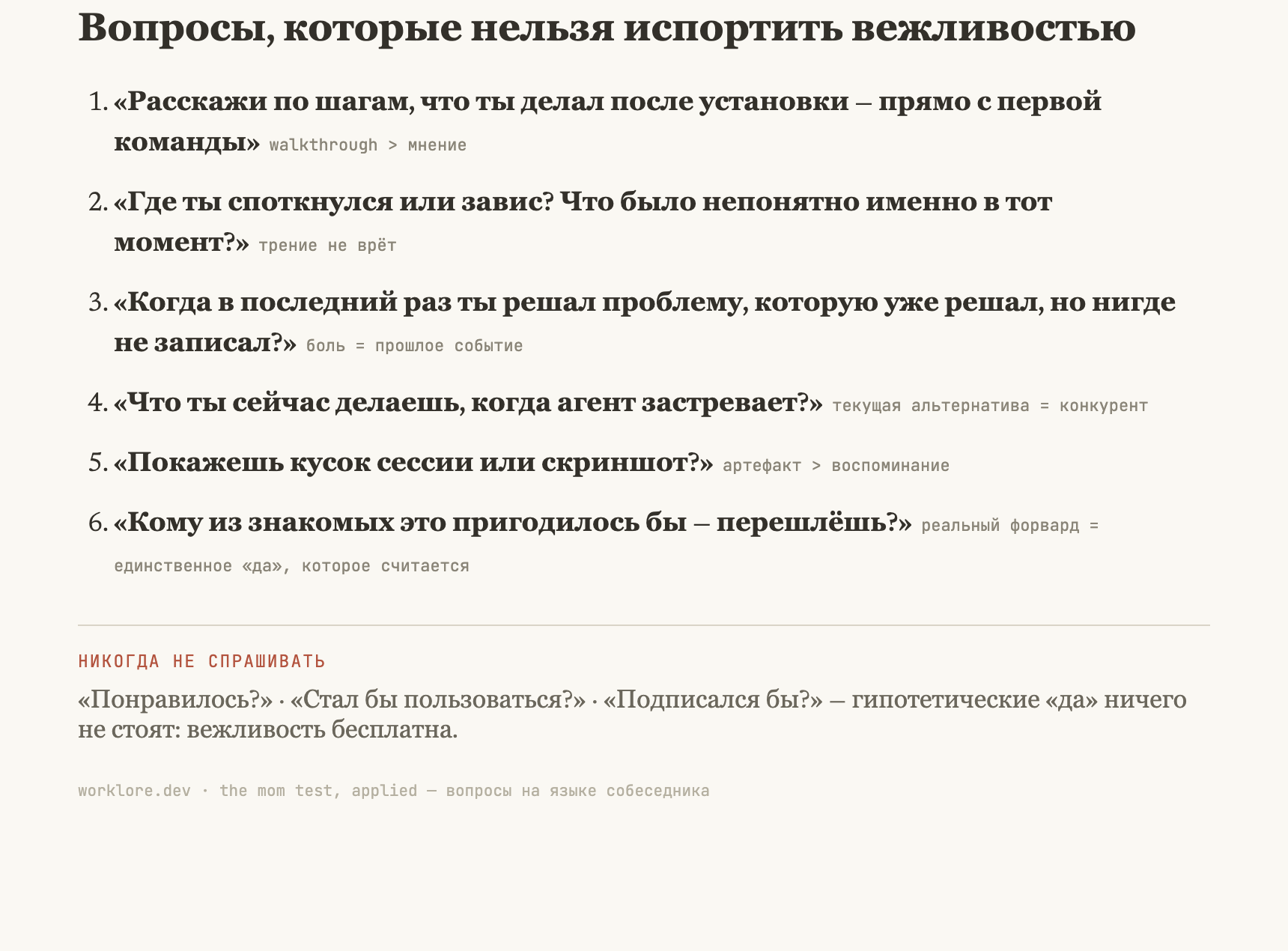
The meta-lesson is the part I want to keep: my memory of the framework was good enough to know a framework existed, and that is all it needs to be. The agent's job is supplying the letter of the method; mine is knowing when to reach for it.
Reproduce this
Prerequisites: an agent that supports skills or plugins (Claude Code, or any tool that consumes SKILL.md-format instructions).
Your agent will need from you: the clue — what you vaguely remember and from where; what you are trying to do; and any raw material to score (a past interview, a draft survey).
Steps:
- First, have your agent check its own inventory: "list the skills you have installed related to <topic>" — agents know their skill list and must name a concrete match, not assume one.
- If nothing matches, install the one this story used: the marketing-skills plugin from https://github.com/coreyhaines31/marketingskills (Claude Code: /plugin marketplace add coreyhaines31/marketingskills, then install; the relevant skill here is form-cro). Or search a skill directory such as skillsmp.com / claudeskills.info for an equivalent in your ecosystem.
- If no skill exists for your method at all, fall back to the canonical source — for user interviews that is The Mom Test by Rob Fitzpatrick — and have the agent apply the book's rules, citing them.
- Tell the agent the feeling-shaped version of the rule you remember; ask it to first SCORE your existing attempt against the method (the gap between your memory and the letter is the useful output), then generate the precise artifact — questions, checklist, script — in the language your users speak.
Verify: your agent can name the exact skill or source it applied — if it cannot cite one, it guessed from memory, which is the failure mode this whole story is about. Then lint the generated questions: zero "would you / would you like" hypotheticals, every question anchored to a specific past event or an observable artifact, and one question that tests commitment rather than opinion.